Lick en français : traduction et définition
Traductions et définitions de mots et expressions en anglais avec Gymglish. Progressez en anglais dès aujourd'hui et testez votre niveau gratuitement.
Testez votre anglais
Test gratuit et sans engagement
4,7 sur App Store, Play Store et Trustpilot.
Plus de 8 000 000 apprenants dans le monde.
Traduction et définition
to lick: lécher
I have a sensitive tongue and don't like licking ice cream. J'ai la langue fragile, je n'aime pas lécher les glaces.
a lick: un coup de langue
a lick (music): un riff (musique)
Exemples
- "Their hair balls are becoming a problem. I'm not sure if they're licking their own fur or your body hair."
- "For the last 2 days we have had to immobilise him. He has been trying to lick his bottom, he keeps dancing to the music in his head, and worst of all, he sometimes tries to polish an imaginary teapot."
- "For the last 2 days we have had to immobilise him. He has been trying to lick his own bottom, he keeps dancing to the music in his head, and worst of all, he sometimes tries to polish an imaginary teapot."
- "A rare Siberian tiger named "Shoshana" escaped from her pen at the San Francisco zoo yesterday night and attacked a crowd of seven teenagers who had been insulting her, seriously injuring all seven of them. An eighth person, a six year old boy named Timothy Aldridge, was licked by the tiger, and later said the tiger's tongue felt "like sandpaper" and that her breath smelled like "muffins"."
- "Escaped tiger mauls seven, licks one"
Exercice 1
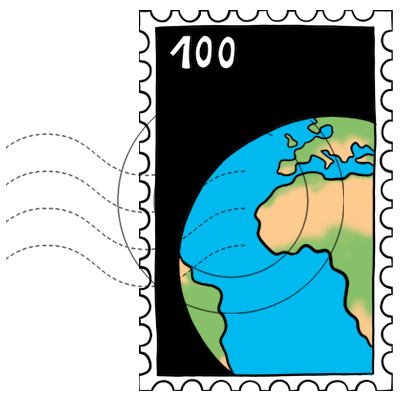
What a nice stamp! Complete the sentences with the correct word.
To attach a stamp to a postcard, we it.
To close a door with a key we it.
If a pipe has a hole and water is coming out, it has a .
To attach a stamp to a postcard, we it.
To close a door with a key we it.
If a pipe has a hole and water is coming out, it has a .
What a nice stamp! Complete the sentences with the correct word.
To attach a stamp to a postcard, we lick 1 it.
To close a door with a key we lock 2 it.
If a pipe has a hole and water is coming out, it has a leak 3.
To attach a stamp to a postcard, we lick 1 it.
To close a door with a key we lock 2 it.
If a pipe has a hole and water is coming out, it has a leak 3.
1 lick: This is correct. "To lick" is to use your tongue to taste (or to make something wet so that it sticks)! Example: I like licking (chocolate) ice cream!
1 lock: This isn't the best choice here. "To lock (a door)" is to secure it with a key. A "lock" is a device used for securing things, usually doors, safes, boxes and windows.
1 leak: This isn't the best choice here. A "leak" is a hole (or crack) through which liquid (or gas), enters or escapes. Example: I think the boat has a leak - we're sinking! Note, "leak" is also used as a verb. Example: Each time it rains, the roof leaks!
2 lock: This is correct. "To lock (a door)" is to secure it with a key. A "lock" is a device used for securing things, usually doors, safes, boxes and windows.
2 lick: This is incorrect. You can try "licking" a door with your tongue, but I'm not sure it would keep the burglars (or house robbers) out!
2 leak: Oops! This doesn't work here! A "leak" is a hole (or crack) through which liquid (or gas), enters or escapes. Example: I think the boat has a leak - we're sinking! Note, "leak" is also used as a verb. Example: Each time it rains, the roof leaks!
3 leak: This is correct. A "leak" is a hole (or crack) through which liquid (or gas), enters or escapes. Example: I think the boat has a leak - we're sinking! Note, "leak" is also used as a verb. Example: Each time it rains, the roof leaks!
3 lock: Sorry, this is incorrect! "To lock (a door)" is to secure it with a key. A "lock" is a device used for securing things, usually doors, safes, boxes and windows.
3 lick: Sorry, this is incorrect! "To lick" is to use your tongue to taste (or to make something wet so that it sticks)! Example: I like licking (chocolate) ice cream!
Exercice 2
Reporter: Mr. Delavigne, could you tell me what it was growing up with Anosmia?
Bruno: Well, I wrote in my autobiography, it was quite difficult. Losing my sense of smell was losing a close friend.
Bruno: Well, I wrote in my autobiography, it was quite difficult. Losing my sense of smell was losing a close friend.
Reporter: Mr. Delavigne, could you tell me what it was like 1 growing up with Anosmia?
Bruno: Well, as 2 I wrote in my autobiography, it was quite difficult. Losing my sense of smell was like 3 losing a close friend.
Bruno: Well, as 2 I wrote in my autobiography, it was quite difficult. Losing my sense of smell was like 3 losing a close friend.
1 like: 'Like' is the best choice here because it correctly completes the interrogative construction 'what was it like? Here 'like' is used to ask Bruno to describe his childhood growing up with Anosmia. 'What was it like?' is a very common question to ask someone to describe a past experience.
1 as: 'As' cannot be used in this construction. When 'as' is used to introduce comparisons, it is generally followed by 'if' or it is used twice in the same clause (Example: It was as funny as anything I have ever heard).
1 lick: 'To lick' doesn't make sense here. 'Licking' describes the act of using the tongue to taste someone or something.
2 as: 'As' is the best choice here, it correctly introduces the clause, and tells us that what Bruno is saying to the journalist is very similar to what he wrote in his autobiography. A common expression in English is 'as I wrote'.
2 similar: We cannot use 'similar' in this sentence because it is grammatically incorrect. However, we could say 'It's similar to what I wrote in my autobiography.
3 like: 'Like' correctly establishes the comparison between having Anosmia and losing a friend. It is the best choice here to compare these two ideas.
3 as: 'As' cannot be used in this type of construction. We must use the preposition 'like' to make this particular comparison.
3 as if: In order to make a correct construction, 'as if' must be followed by the subject of the sentence (It was as if he didn't see me).
Exercice 3
Polly: Mr. Oléré, what was it to live in the jungle?
Horatio: Well Señorita Polly, in the jungle I had total freedom. I felt a fish in the ocean or a monkey in a tree. It was very different than this laboratory and these offices.
Polly: Mr. Oléré, you may be aware, the Delavigne Corporation is not the jungle.
Horatio: Yes Señorita Polly, but the Amazon will always be in my heart and in my perfumes!
Horatio: Well Señorita Polly, in the jungle I had total freedom. I felt a fish in the ocean or a monkey in a tree. It was very different than this laboratory and these offices.
Polly: Mr. Oléré, you may be aware, the Delavigne Corporation is not the jungle.
Horatio: Yes Señorita Polly, but the Amazon will always be in my heart and in my perfumes!
Polly: Mr. Oléré, what was it like 1 to live in the jungle?
Horatio: Well Señorita Polly, in the jungle I had total freedom. I felt like 2 a fish in the ocean or a monkey in a tree. It was very different than this laboratory and these offices.
Polly: Mr. Oléré, as 3 you may be aware, the Delavigne Corporation is not the jungle.
Horatio: Yes Señorita Polly, but the Amazon will always be in my heart and in my perfumes!
Horatio: Well Señorita Polly, in the jungle I had total freedom. I felt like 2 a fish in the ocean or a monkey in a tree. It was very different than this laboratory and these offices.
Polly: Mr. Oléré, as 3 you may be aware, the Delavigne Corporation is not the jungle.
Horatio: Yes Señorita Polly, but the Amazon will always be in my heart and in my perfumes!
1 like: 'Like' is the best choice here. 'What was it like?' is the proper form of the question. We use this construction when we are asking for an opinion or a description of someone/something, for example: What was your hotel like? -Fabulous.
1 as: We cannot use 'as' here because it is grammatically incorrect to ask 'What was it as?'.
1 lick: 'To lick' is a verb which means to taste with your tongue ('I like licking ice cream'). It has no place in this sentence, however.
2 like: 'I felt like' is the best choice to express Horatio's metaphor. As a preposition, 'like' is often preceded by verbs like 'feel/taste/sound/look/smell', for example: I don't feel like going out tonight, I'm too tired.
2 as: 'As' doesn't fit here because 'felt as' is not the best way to complete the metaphor. We could say 'I feel as a fish feels', but we must use the verb twice to make the sentence grammatically correct.
3 as: 'As' is the correct choice here. In reports/explanations/emails etc, 'as' often introduces clauses which point forward or back, for example: As you already know, I am leaving for Spain next Tuesday...
3 like: Although 'like' is grammatically correct here, the proper expression requires 'as'. 'Like' is only used in this type of construction before the verb 'to say', for example: Like I said yesterday, I am not interested in your offer (or 'As I said yesterday...').
Exercice 4
What a nice stamp! Complete the sentences with the correct word.
To attach a stamp to a postcard, we it.
To close a door with a key we it.
If a pipe has a hole and water is coming out, it has a .
To attach a stamp to a postcard, we it.
To close a door with a key we it.
If a pipe has a hole and water is coming out, it has a .
What a nice stamp! Complete the sentences with the correct word.
To attach a stamp to a postcard, we lick 1 it.
To close a door with a key we lock 2 it.
If a pipe has a hole and water is coming out, it has a leak 3.
To attach a stamp to a postcard, we lick 1 it.
To close a door with a key we lock 2 it.
If a pipe has a hole and water is coming out, it has a leak 3.
1 lick: This is correct. "To lick" is to use your tongue to taste (or to make something wet so that it sticks)! Example: I like licking (chocolate) ice cream!
1 lock: This isn't the best choice here. "To lock (a door)" is to secure it with a key. A "lock" is a device used for securing things, usually doors, safes, boxes and windows.
1 leak: This isn't the best choice here. A "leak" is a hole (or crack) through which liquid (or gas), enters or escapes. Example: I think the boat has a leak - we're sinking! Note, "leak" is also used as a verb. Example: Each time it rains, the roof leaks!
2 lock: This is correct. "To lock (a door)" is to secure it with a key. A "lock" is a device used for securing things, usually doors, safes, boxes and windows.
2 lick: This is incorrect. You can try "licking" a door with your tongue, but I'm not sure it would keep the burglars (or house robbers) out!
2 leak: Oops! This doesn't work here! A "leak" is a hole (or crack) through which liquid (or gas), enters or escapes. Example: I think the boat has a leak - we're sinking! Note, "leak" is also used as a verb. Example: Each time it rains, the roof leaks!
3 leak: This is correct. A "leak" is a hole (or crack) through which liquid (or gas), enters or escapes. Example: I think the boat has a leak - we're sinking! Note, "leak" is also used as a verb. Example: Each time it rains, the roof leaks!
3 lock: Sorry, this is incorrect! "To lock (a door)" is to secure it with a key. A "lock" is a device used for securing things, usually doors, safes, boxes and windows.
3 lick: Sorry, this is incorrect! "To lick" is to use your tongue to taste (or to make something wet so that it sticks)! Example: I like licking (chocolate) ice cream!
Pour ne plus oublier la traduction en français de 'Lick' et progresser en anglais à l'écrit comme à l'oral, découvrez nos cours d'anglais en ligne Gymglish !
Ils parlent de nous :
Evaluez votre niveau d'anglais gratuitement avec Gymglish, cours d'anglais en ligne.
Testez votre anglais