4,7 su App Store, Play Store e Trustpilot
Più di 8 milioni di utenti in tutto il mondo.
Traduzione e definizione
to carry: portare, trasportare verb
to carry on (doing something): continuare (a fare qualcosa) idiom
Please, carry on with the meeting. I'll be with you in a moment. Per favore, continuate pure con la riunione. Sarò da voi tra un momento.
Pronunciation examples
UK: Beethoven carried on writing music even though he was deaf.
US: Can I carry your bag for you?
Esempi
"I will carry you!"
"Early reaction to the announcement has been mixed: Some have praised Delavigne Corp for its audacity, saying that the products, as well as the increased price tag they will likely carry, are well worth the price for the peace of mind they will provide."
"Bruno : Susie, I can carry you all the way to Phnom Penh!"
"Host : I am the tubes which carry blood around the body and to the heart."
"Sigourney : I'd like to carry on, if you don't mind."
"While driving to the International Conference on Smelling Techniques, Bruno's tiny Peugeot collided with an enormous truck carrying several boxes of Kalvin Krime products."
"Are you carrying any of the following items: Acids, ammunition, animals, corpses, cremated remains, explosives, firearms, fireworks, flammable liquids, hazardous materials, materials with a disagreeable odor, matches?"
"Xavier taught me the perfume trade because he wanted me to take over his business, and carry on his legacy."
"The person I'm carrying is overweight"
"Moira : Carry on eating those burgers, Brent, and you could be elected next year."
"Sailor : Horatio, it's great to have you aboard, but why do you always carry that bloody arm holding a gun with you?"
"I was carrying a box of cornflakes when I slipped in a puddle of orange juice on the floor."
"Moreover, US pollution is being carried by wind currents towards the South Pole, close to Australia."
"While driving to the International Conference on Smelling Techniques, Bruno's tiny Peugeot collided with an enormous truck carrying several boxes of Kalvin Krime perfumes."
"Carry on as usual."
"Ray Upton, there are 5 B-2 stealth bombers currently surrounding your aircraft, each carrying missiles with a nuclear payload of 6 megatons."
"I shall be wearing a pink carnation and carrying a copy of The Financial Times - folded."
Esercizio 1
to single out | to catch on | to carry on
Fill in the blanks below with the appropriate expression. Each term is used once.
Remember to conjugate the verbs appropriately!
Lions try a young animal when attacking a group. They have a greater chance of success when this animal is separated from the others.
The President talking yesterday despite the rotten tomatoes the audience were throwing at him.
It seems unlikely that your idea for a transparent swimming costume will , Philip.
to single out | to catch on | to carry on
Fill in the blanks below with the appropriate expression. Each term is used once.
Remember to conjugate the verbs appropriately!
Lions try to single out1 a young animal when attacking a group. They have a greater chance of success when this animal is separated from the others.
The President carried on2 talking yesterday despite the rotten tomatoes the audience were throwing at him.
It seems unlikely that your idea for a transparent swimming costume will catch on3, Philip.
1to single out: This is correct. The expression 'to single (somebody, something) out' means 'to select from a group' or 'to isolate'. Example: 'She was singled out for special treatment by her teacher'. We need the infinitive form of the verb here, because when the verb 'to try' is followed by a second verb, this must be in the infinitive (with 'to'). Example: 'I will try to arrive on time'. This is the same usage as in the conversation, when Bruno says 'It would be unfair to single out just one'.
2carried on: This is correct. The expression 'to carry on (doing something)' means 'to continue'. Example: 'If you carry on crying, I will have to leave'. We need the simple past form of the verb here, to describe a completed action in the past (which happened 'yesterday'). Note that the term 'to carry on' is followed by a verb ending in '-ing'. As we hear in the conversation, the term 'to carry on' can also be used alone, without a second verb: 'I'd like to carry on, if you don't mind'. Note that the verb 'to carry' is irregular: carry/carried/carried.
3catch on: This is correct. The expression 'to catch on' means 'to become popular'. Example: 'Recycling has really caught on in recent years'. In this example, the future tense is used, formed by 'will' + infinitive (without 'to'). Note that the verb 'to catch' is irregular: catch/caught/caught.
Esercizio 2
Because there's nothing more important than fashion, fill in the blanks below with the following terms used in Brian's email.
are pieces of cloth that you can tie around your neck, often colorfully printed or dyed.
are used to carry personal items, and although most women own at least five of them, this is never enough.
are necessary if you want to keep your pants or trousers from falling down.
decorate the buttonholes at the end of shirtsleeves. Their purpose is usually to show how smart a man is.
Fashion are all various items that complement your outfit. While not necessary, they help turn you into the cool and trendy person you are.
Because there's nothing more important than fashion, fill in the blanks below with the following terms used in Brian's email.
scarves1 are pieces of cloth that you can tie around your neck, often colorfully printed or dyed. handbags2 are used to carry personal items, and although most women own at least five of them, this is never enough. belts3 are necessary if you want to keep your pants or trousers from falling down. cufflinks4 decorate the buttonholes at the end of shirtsleeves. Their purpose is usually to show how smart a man is.
Fashion accessories5 are all various items that complement your outfit. While not necessary, they help turn you into the cool and trendy person you are.
1scarves: A scarf (plural: "scarves") can be worn by a man or woman, and is often tied neatly around the neck. In cold climates, scarves are usually "knitted" using wool to keep the neck warm. The "neck" is the part of the body in between the head and the shoulders.
2handbags: This is the correct answer. A handbag (plural: "handbags") is a small purse, a container used for carrying money and small personal items or accessories (especially by women). Note that the men's equivalent is sometimes called a "manbag". To "carry (a purse)" is to hold it in one's hands, or on some other part of the body.
3belts: This is the correct answer. A belt (plural: "belts") is a piece of material, often a leather band, worn around the waist of pants to ensure that they fit snugly and don't fall down. Belts can also be worn simply for show, as accessories.
4cufflinks: This is the correct answer. A cufflink (plural: "cufflinks") is a fastening for a shirt cuff (the end of a shirtsleeve, which goes around a person's wrist), often made out of two buttons or button-like parts connected with a chain that passes through two holes in the cuff.
5accessories: This is the correct answer. An accessory (plural: "accessories") is a non-essential item, often of clothing. It contributes to an overall "look", but it is not necessary in the way that, say, a shirt is necessary. For example, "I only buy earrings and other accessories that go well with my red hair".
Esercizio 3
Match the following terms and expressions with the best definitions. Use the context to help you.
Don't let me bother you = Don't let me you.
To carry on with an activity is to it.
In the context of the scene you just heard, to get the phone is to the phone.
Match the following terms and expressions with the best definitions. Use the context to help you.
Don't let me bother you = Don't let me disturb1 you.
To carry on with an activity is to continue2 it.
In the context of the scene you just heard, to get the phone is to answer3 the phone.
1disturb: "To bother" is a verb close to "disturb", and the two terms are interchangeable in this expression. "Don't let me bother you" is an invitation to act normally, or continue to do something as if no one else was present.
1frustrate: To "frustrate" means to irritate or cause annoyance or irritation. Although "bothering" someone can sometimes include frustration or irritation, in this context, "bother" is closer in meaning to "disturb".
1bore: "To bore (someone)" is to say or do something which does not interest ot excite another person. Example: This movie is boring me. Isn't there anything else we can watch? "Bore" and "bother" do not share a close meaning.
2continue: "To carry on (swimming)" is to "continue" swimming, or to "keep" swimming, generally while another activity or incident may interrupt the action. For example: We carried on with the play even after the main actor quit. "Carry on", the instruction that Bruno gives Edward and Brian, is commonly given when you wish someone to continue an action, despite your presence.
2interrupt: "To carry on (doing something)" and "to interrupt (an action)" express nearly opposite meanings. To "interrupt (a discussion)" is to "cut" or break into it. For example: Bob interrupted our meeting several times in order to sing "Happy Birthday" to his dog.
2begin: "To begin (eating dinner)" is to commence or start eating it. This verb has a different meaning than to "carry on", which describes a continuation of an action, and not the start of one.
3answer: This is the best answer. "Get the phone" is an instruction to "answer" or "pick up" the telephone. Example: Can you get the phone? I'm busy right now. Note that in another context, "get the phone" could refer to buying, obtaining or transporting a phone. Ex: I'm going to the store to get a phone. Do you need anything?
3obtain: In this context, "obtaining" or "procuring" a phone isn't the best answer here. "Get the phone" is an order to pick up or answer the phone. Note that in another context, "get" can express "obtaining" or "procuring" an item. Example: Please go to the store and get me some orange juice and eggs.
3ignore: "Ignore" and "get" don't share a similar meaning in this context or any other.
3hang up: "To hang up (a telephone, on someone)" is to end a telephone call, generally by placing the receiver of the telephone on the "cradle" or "base" of the phone. The term doesn't share a similar meaning with "to get the phone".
Esercizio 4
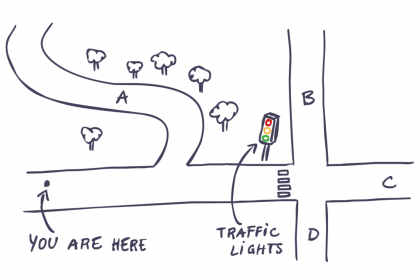
Edward draws a map to help the man. Listen to the audio clip and decide which street the man should take to get to the Castro District.
Edward draws a map to help the man. Listen to the audio clip and decide which street the man should take to get to the Castro District.
This is the incorrect road to take. The directions for taking this road would be "the first left before the traffic lights". "Traffic lights" describe the 3 colored lights (red, amber, green) which regulate vehicles and traffic.
"B" is the correct answer. In order to get to the Castro District, Edward tells the man to "carry along this road" and "take a left at the traffic lights". "To carry on/along a road)" is "to continue" (to travel) on it. Example: We carried along the highway until we found our car. "To take a left / right" is "to turn" left or right.
This is the incorrect road to take.The directions for taking this road would be "go straight on at the traffic lights". "Traffic lights" describe the 3 colored lights (red, amber, green) which regulate vehicles and traffic.
This is the incorrect road to take. The directions for taking this road would be "go right after/at the traffic lights". "Traffic lights" describe the 3 colored lights (red, amber, green) which regulate vehicles and traffic.
Esercizio 5
The following verbs were all used in the dialogue. Use them to complete the sentences below. Not all the words are used, and you may have to change the tense!
to shape | to excrete | to carry | to inject | to locate | to maintain
I am like my mother. We're both rather fat.
Last night, the nurse me with morphine. I felt great!
If you blood when you go to the toilet, you should visit your doctor.
I've just lost a lot of weight. I hope I can this body through regular exercise!
The following verbs were all used in the dialogue. Use them to complete the sentences below. Not all the words are used, and you may have to change the tense!
to shape | to excrete | to carry | to inject | to locate | to maintain
I am shaped1 like my mother. We're both rather fat.
Last night, the nurse injected2 me with morphine. I felt great!
If you excrete3 blood when you go to the toilet, you should visit your doctor.
I've just lost a lot of weight. I hope I can maintain4 this body through regular exercise!
1shaped: This is the right answer. The shape of someone is the form of their body: fat, thin, voluptuous, skinny etc. It describes their appearance and build. For example, "I'm not shaped like a model. I look more like a bus".
2injected: This is the right answer here. To "inject" means to introduce into the bloodstream with a needle or syringe. Synonyms include to "give a shot" and "to vaccinate". Example: "The nurse injected me with an anti-malaria drug before I went on holiday".
3excrete: This is the correct verb in the correct tense. To "excrete" means to eliminate foreign substances or waste from the body. To "perspire", "defecate", "urinate", "ejaculate"... these are all examples of bodily excretions. You may be reading this very early in the morning, so we won't continue with any more detailed descriptions.
4maintain: This is correct. To "maintain" means to "conserve", to "continue" or to "prolong". For example, "I maintain my level of German by reading German newspapers once a week".
Hai ancora difficoltà con 'Carry' (vocabolario inglese)? Prova il nostro corso di inglese online e ricevi una valutazione del livello gratuita!