4,7 en App Store, Play Store y Trustpilot.
Más de 8.000.000 de usuarios en todo el mundo
Traducción & Definición
(on your) right: (a tu) derecha noun
You'll find the bus stop on your right as you exit the building. Cuando salgas del edificio, encontraras la parada de bus a tu derecha.
(on your) left: (a tu) izquierda noun
Take a left after the stop light. Gira a la izquierda después del semáforo.
Ejemplos
""Accounts Receivable" on the left, and "Accounts Payable" on the right, but now they're all mixed together."
"We'll be using conference room A this time, that's on the 15th floor on the left hand side, next to the elevators."
"More importantly, coming up on your left is Fenway Park, home of the 2007 World champions of baseball, the Boston Red Sox!"
"Hop in it and take it about two miles down the trail, and then you'll see the guesthouse on your right."
"Do we drive on the right or on the left?"
"Conductor : On your left you can see the Charles River, named after King Charles I of England."
"On your left is the office of our Chief Financial Officer, Icarus Quincy."
"On your left, is the office of our Chief Financial Officer, Icarus Quincy."
"Philip : No, I said left on Guererro Street, then the burrito place is on your left hand side."
"Do we drive on the right or on the left?"
"You just go down that corridor, past the water cooler, and the toilets are on your left."
"And on the right is the dining room, where we take our dinner."
"(Drive on the left)"
"The Queen : So, on the left is the tea room. It's where we take our tea!"
"We drive on the left"
""Accounts Receivable" on the left, and "Accounts Payable" on the right, but now they're all mixed together."
Ejercicio 1
Fill in the blanks below with the proper directional term.
In many languages such as English, French, German and Spanish, we read and write text from to .
The shortest distance between two points is a line.
Fill in the blanks below with the proper directional term.
In many languages such as English, French, German and Spanish, we read and write text from left1 to right2.
The shortest distance between two points is a straight3 line.
1left: In English, Spanish, German and French we read text from left to right. When talking about directions, we can "turn left", "take a left" or "make a left".
2right: In English, Spanish, German and French we read text from left to right. When talking about directions, we can "turn right", "take a right" or "make a right".
3straight: The shortest distance between two points is a straight line. We use the term "straight" very often when giving directions, such as "straight ahead" or "straight across". The "gh" is silent in English, and the word is pronounced "strate".
Ejercicio 2
Complete Eva's song with the terms she uses!
Hello, hello we are the British, yeah We on the But we ride horses At the Queen's
Hello we are the British, yeah We all day Because our food is so And our are
Complete Eva's song with the terms she uses!
Hello, hello we are the British, yeah We drive1 on the left2 But we mostly3 ride horses At the Queen's request4
Hello we are the British, yeah We drink5 all day Because our food is so awful6 And our skies7 are grey8
1drive: "Drive" is the right answer here. To "drive" is to direct or control something, usually a vehicle (car, bus, lorry, etc.). Example: "You can't drive a car unless you have a licence".
2left: "Left" is the term Eva uses here. Most people write with their "right" hand, but around 10% of people write with their LEFT hand. In the majority of countries, traffic drives on the right-hand side of the road, but in some countries, people drive on the left. Countries where people drive on the left include Britain, India, Australia, Japan, and South Africa.
3mostly: "Mostly" is the correct answer. The term "mostly" means "generally", "mainly", or "the majority of (the time)". Eva is saying that the majority of British people travel by horse most often! You should note that this isn't entirely true. Here's another example of "mostly" in action: "I mostly listen to rock music, but sometimes I listen to jazz".
4request: "Request" is the right term here. When we "make a request", we "ask for something" politely, or formally. To do something "at the Queen's request" is to do something "because the Queen has asked you to". Example: "At Bruno's request, all the staff came to the office on Sunday".
5drink: "Drink" is the word which Eva sings here. To "drink" is to consume a liquid. In the context of Eva's song, "to drink" means specifically "to drink alcohol". Note that this verb is irregular: drink/drank/drunk. When someone drinks too much alcohol, they are described as "drunk".
6awful: "Awful" is the correct word here. "Awful" means "horrible", "terrible", or "very bad". Eva is saying that the food eaten in Britain is disgusting! Another example: "Horatio is an awful singer: glasses smash when he sings!".
7skies: The correct answer here is "skies". "Skies" is the plural of "sky", and both terms refer to the atmosphere above the earth, where we can see the sun and clouds. Eva sings that the skies above Britain are grey, meaning that it often rains in Britain.
8grey: "Grey" is the term which Eva sings here. By saying that the skies in Britain are grey, she is saying that it is rarely sunny in Britain. Note that this word is written as either "grey" or "gray" in British English, but always "gray" in American English.
Ejercicio 3
In her email, Polly uses the word "right" in several different ways. Choose the most appropriate definition for each sentence or phrase.
it won't function right = Right now, I'm typing on this thing = Call my "talk box" right away =
In her email, Polly uses the word "right" in several different ways. Choose the most appropriate definition for each sentence or phrase.
it won't function right = it won't function correctly1 Right now, I'm typing on this thing = Currently, I'm typing on this thing2 Call my "talk box" right away = Call my "talk box" immediately3
1it won't function correctly: In this phrase, "right" is being used to express the sense of "working correctly" or "working properly". Note: in proper written English, the phrase should be written "it won't function correctly" or "it won't work the right way". An adverb is preferable in place of "right", but remember that Polly is using a computer without an "e" key!
1it won't function in one direction: In a different context, "right" can express direction, but this is not the case here.
1it won't function presently: The expression "right now" expresses the same sense as "currently" or "at the present time", but this expression is not present here.
1it won't function immediately: The expression "right away" expresses the same sense as "immediately" or "very soon", but this expression is not present here.
2Currently, I'm typing on this thing: The expression "right now" expresses the sense of the "present moment". Polly is typing on this "thing" at the "present moment".
2Actually, I'm typing on this thing: Be careful! In English, "actually" is synonymous with "in fact" or "in reality". The term is unrelated to the time at which an action occurs.
2I'm typing on this thing properly: In a different context, "right" can express the sense of something being "correct" or "proper", but this is not the case here.
2I'm typing on this thing immediately: The expression "right away" expresses the same sense as "immediately" or "very soon", but this expression is not present here.
3Call my "talk box" immediately: Polly is instructing Bob to call her "right away". The expression "right away" is synonymous with "immediately" or "very soon".
3Call my "talk box" currently: Do not confuse the expression "right away" with the idiom "right now", which expresses a similar meaning to the adverb "currently" and the phrase "at the present time".
3Call my "talk box" correctly: In a different context, "right" can express the sense of something being "correct" or "proper", but this is not the case here.
3Call my "talk box", okay?: In a different context, "right?" can be used to ask whether something is "acceptable" or "correct", but this is only the case in interrogative constructions! Because there is no question mark here, we know that this is not the best choice here.
Ejercicio 4
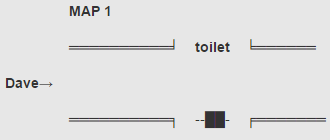
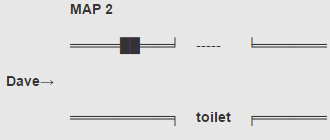
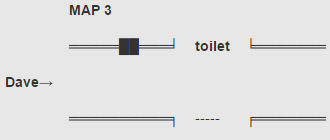
The following maps correspond to Hannah's directions for Dave.
(key: ██ = water cooler)
Which of the maps best describes the relative positions of the toilet and water cooler?
The following maps correspond to Hannah's directions for Dave.
(key: ██ = water cooler)
Which of the maps best describes the relative positions of the toilet and water cooler?
This is incorrect. For Map 1 to be correct, Hannah would have needed to say something like: "go down that corridor, and the toilets are on your left, OPPOSITE (not past) the water cooler".
This is incorrect. For Map 2 to be correct, Hannah would have needed to say something like: "go down that corridor, past the water cooler, and the toilets are on your RIGHT (not left)".
Map 3 correctly describes the relative positions of the toilet and water cooler. Hannah tells Dave to "go down that corridor, past the water cooler, and the toilets are on your left". "To go down" (a corridor) is "to take" or "follow" (a corridor). "Past" is a preposition of place that indicates that something is beyond, or further than, something else. Example: When you reach Carol Street, the post office is just PAST the bank.
¿Aún tienes dificultades con 'Rightleft' (Vocabulario inglés)? ¡Prueba nuestro curso de inglés en línea y recibe una evaluación de nivel completamente gratis!